
Consciousness and the Nature of Reality
Updated: Jun 30
Is consciousness merely produced by the brain, or is it one of the hidden foundations through which reality itself becomes perceptible?
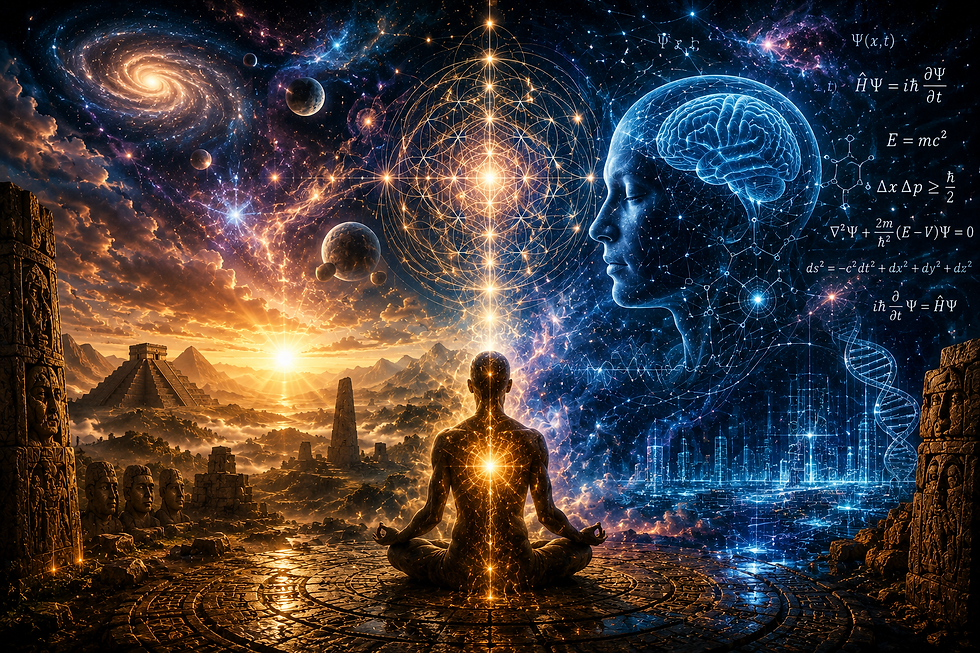
Consciousness and the Nature of Reality
What Is Reality?
At first glance, the answer seems straightforward. Reality is what we see, touch, measure, and experience through our senses. It is the physical world around us: matter, energy, space, time, and the countless objects and events that appear to exist independently of our observation.
Yet this definition begins to unravel as soon as we examine reality more closely. As our understanding deepens, a far more mysterious world emerges before us. Matter dissolves into fields, particles, probabilities, and mathematical structures. Time becomes relative. Space becomes flexible. And the observer—once regarded as separate from the observed universe—becomes increasingly difficult to remove from the act of knowing, standing at the very center of the mystery we call consciousness.
In Dominium: Our Hidden Reality, consciousness is not treated as a secondary byproduct of matter. Instead, it is approached as one of the most profound questions in the investigation of existence itself. The book asks whether consciousness is merely produced by the brain, or whether it is connected to a deeper and more fundamental layer of reality—one that precedes, informs, or interacts with the physical world.
This question changes everything.
If consciousness is nothing more than a biological function, then the human mind is an isolated phenomenon, confined to the nervous system and extinguished when the body dies. But if consciousness is something more fundamental, then the brain may not be its source. It may instead function as an interface, a receiver, a filter, or an anchor through which a deeper field of mind expresses itself within physical reality.
This becomes one of the central philosophical tensions explored throughout Dominium.
Modern science has achieved extraordinary success in its study of the measurable world. It has revealed the structure of atoms, the laws of motion, the expansion of the universe, the genetic code, and the hidden forces that govern matter. Yet the inner experience of being—the simple fact that we are conscious—remains one of the greatest unsolved problems ever encountered.
We can map neural activity, observe brain states, and measure electrical patterns. Yet none of these measurements fully explains why subjective experience exists at all.
Why is there an inner world?
Why does matter become aware of itself?
Why does the universe contain not only stars, atoms, and galaxies, but also memory, imagination, fear, love, intuition, symbolic thought, and the sense of “I am”?
These questions cannot be dismissed as mere philosophical abstractions. They touch the very foundation of what reality means.
According to the perspective presented in Dominium, reality may not be a flat, purely material stage upon which consciousness emerges by chance. Instead, reality may consist of multiple layers—a structure composed not only of matter and energy, but also of information, perception, memory, symbolic patterns, and fields of consciousness that interact with the visible world in ways we do not yet fully understand.
From this perspective, the human being is more than a biological organism moving through space and time. A human being is also a point of consciousness, a living center of interpretation, and a bridge between the measurable and the immeasurable. The implications of such a view are profound.
If consciousness plays a role in how reality is perceived, then our understanding of the universe can never be entirely neutral. Every model of reality is filtered through the limitations of the observer. Every scientific theory, philosophical system, religious doctrine, and cultural worldview is shaped by the consciousness that constructs and interprets it.
The world we call “real” may therefore represent only one layer within a much larger architecture.
This does not mean abandoning science. On the contrary, it means expanding the range of questions science is willing to explore. A mature investigation of reality cannot ignore the observer. It cannot treat consciousness as an inconvenience simply because it does not fit neatly into current equations.
The unknown should not be rejected because it is difficult. Rather, it should be investigated precisely because it is complex and mysterious.
Throughout Dominium, consciousness is connected to many of the book’s broader themes: time, memory, multidimensional reality, anomalous phenomena, UFOs/UAPs, spiritual experiences, ancient symbolic systems, hidden histories, and the possibility that human existence is part of a far larger structure than we have been taught to imagine.
In this sense, consciousness becomes more than an object of study. It becomes a key to understanding the mystery of perception, the relationship between mind and matter, the possibility of realities beyond ordinary sensory experience, and, above all, the question of whether human identity extends beyond the physical body.
Perhaps reality is not simply something “out there,” but something in which we actively participate. And perhaps consciousness is not merely a candle briefly illuminated within the darkness of matter, but one of the hidden lights through which the universe becomes aware of itself.
Dominium: Our Hidden Reality invites readers to look beyond the surface of existence and reconsider the oldest mystery of all: not merely what the universe is, but who—or what—is experiencing it.
The visible world may be only the beginning. Yet the deepest question remains the same: what are the definition, nature, and function of consciousness in the creation and observation of our own reality?


Comments