
Beyond Time and Space: The Quantum Connection
Updated: Jun 30
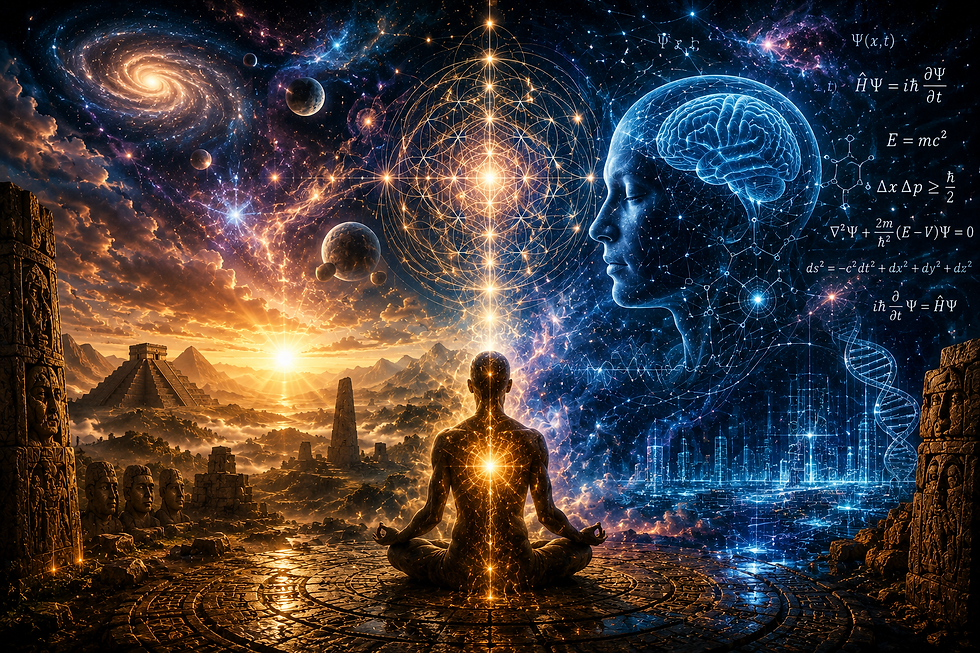
What if time and space are not the ultimate foundations of reality, but interfaces through which consciousness experiences a deeper quantum architecture?

Beyond Time and Space: The Quantum Connection
When we pause from our daily tasks and take a moment to observe the world around us, time and space seem like the most obvious realities of human existence.
We wake up, move, remember, grow old, travel, wait, return, and disappear within them. Everything we experience seems to happen somewhere and at some point. A body occupies space. Life unfolds in time. A memory belongs to the past. A possibility awaits in the future.
However, the deeper we look into the structure of reality, the less stable these foundations seem. And modern physics has already shown that time is not as absolute as common perception suggests. Space is not an empty element. Matter is not solid in the simple sense imagined by common sense. When we turn to the quantum scales, reality becomes strange, probabilistic, relational, and deeply dependent on information. In this way, the world we experience may, therefore, be less like a fixed stage and more like a kind of interface.
Dominium: Our Hidden Reality starts from this threshold: the possibility that reality is not composed solely of matter and energy, but also of deeper informational, dimensional, and conscious structures. In this view, time and space may not be the final architecture of our existence. They may be the visible surface of something far more complex.
The quantum world forces us to rethink what “the notion of real” means. A particle can behave like a wave, where a measurement can alter what is observed.
In this world, distance may not fully separate entangled systems. And the past and future may not be as isolated as common consciousness assumes. In this quantum reality, information may be more fundamental than the objects that seem to carry it.
These ideas do not belong merely to physics laboratories. They challenge the philosophical foundation of human identity. If reality at its deepest levels is not fixed, local, and linear, then consciousness may not be merely a passive observer within a mechanical universe. And consciousness may be linked to the way reality becomes experience.
This is the quantum connection explored symbolically and philosophically in Dominium: the relationship between mind, matter, time, space, memory, and hidden layers of reality. The book does not treat these themes as isolated subjects. It places them within a broader investigation of existence itself, where time is not merely a line and space is not merely distance. Matter, in this context, is not treated as mere substance, and consciousness is not merely an effect of the brain.
The familiar world may be a translation—a stable interpretation of deeper fields, dimensions, patterns of information, and interactions that our senses reduce to something coherent enough for our daily lives. And that is why human perception is so important.
We do not experience reality directly in its entirety. We experience a filtered version of it. Our senses, nervous system, memory, language, culture, and expectations shape the world that presents itself before us. What we call “reality” may be the result of a negotiation between the external universe and the consciousness that interprets it.
In everyday life, this interface seems seamless. However, in extraordinary moments—dreams, altered states, intuition, anomalous experiences, near-death accounts, mystical states, UFO encounters, synchronicities, and experiences of lost or distorted time—the interface can weaken. Something deeper may become visible for a brief instant, in the blink of an eye.
These moments suggest that time and space may not be closed walls, but liminal realities.
A UFO encounter that seems to distort time, a memory that seems to reach far beyond ordinary chronology, a symbolic vision that seems more real than imagination, or an intuition that arises before the event it describes—all of these challenge the assumption that consciousness is trapped within a single linear present.
In the context of "Dominium", such phenomena can be interpreted as signs that reality contains hidden layers. These layers may not obey the same rules that govern everyday perception. They may operate through non-locality, resonance, symbolic communication, information transfer, or forms of interaction that seem impossible simply because our current model for interpreting reality is incomplete.
Quantum entanglement does not refer only to particles. We can view it as the interplay of relationships and a hidden link between observer and observed, between memory and time, between symbol and event, between physical structure and conscious experience. It concerns the possibility that reality is not constructed solely from inert matter, but from dynamic patterns of information capable of becoming world, body, mind, and history. And this possibility profoundly transforms the meaning of human existence.
If consciousness is connected to deeper structures of reality, then the human being is not merely a biological machine moving through an indifferent cosmos. The human being becomes a point of intersection—a place where matter, memory, time, perception, and meaning converge.
In this sense, the brain may not be the creator of consciousness in a merely mechanical way. It may be an interface through which consciousness enters, interprets, and stabilizes physical experience. Memory may not be merely storage in neural tissue, but part of a broader informational process. Time may not be merely a sequence of moments, but a structure through which consciousness organizes change. And this does not mean abandoning science but asking broader questions.
Science gives us tools to measure the visible world. In philosophy, we ask what these measurements mean. Metaphysics asks what must exist for experience to be possible. The study of consciousness asks who or what is experiencing. Dominium brings these inquiries together and questions whether the boundary between them is artificial.
The unknown often arises where disciplines refuse to engage in dialogue with one another. And quantum physics without consciousness risks becoming mathematics without experience. Spirituality without critical inquiry risks becoming mere belief without structure. Ufology without the study of the mind risks reducing encounters to machines in the sky. Metaphysics without contact with science risks straying from disciplined inquiry. And the deepest mystery may require the presence of all of them.
Beyond time and space, reality may not be empty. It may be informational, relational, multidimensional, and conscious in ways we have only begun to suspect. In this way, the universe may not simply contain consciousness, but it may be accessible through consciousness. And if that is true, then the greatest frontier lies not only beyond the stars, nor only within the atom, but at the point where the human mind encounters the hidden architecture of existence.
Thus, perhaps time is a veil, space a language, matter a projection, and consciousness the key that allows the universe to know itself.
Dominium: Our Hidden Reality invites the reader to take their place at this frontier—where physics becomes philosophy, where consciousness meets the quantum mystery, and where the visible world begins to reveal a deeper order behind it.
The journey beyond time and space may not take us away from reality but bring us closer to what reality has always been, even if we fiercely deny it upon our first deeper encounter with it.

Comments